3 August 2026
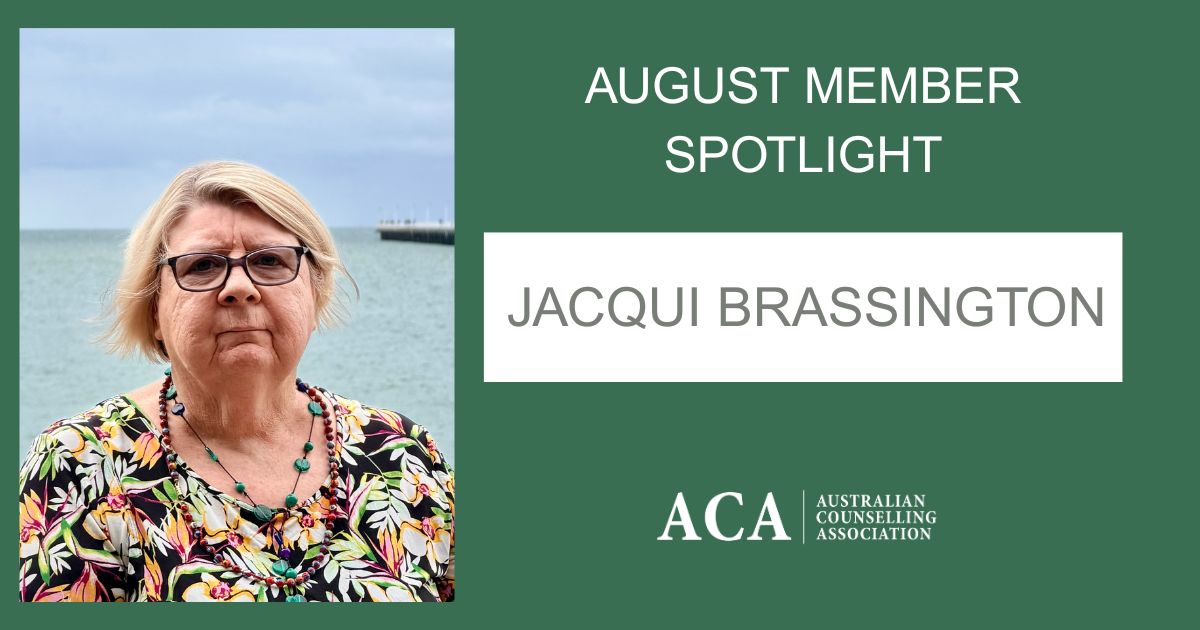
Meet Jacqui Brassington
Each month we spotlight an ACA member in the ACA Monthly Bulletin, our monthly newsletter. The Member Spotlight is designed to showcase the work of our members to you! We hope their stories inspire or spark interest. Let’s share our experiences within our counselling community.
What motivated you to pursue a career in counselling/psychotherapy?
My entry into formal counselling began through community volunteer work, following a rewarding seventeen-year career as a family daycare provider. When an unexpected injury brought that chapter to an abrupt end in 2008, it triggered a significant period of family life transitions. Navigating that personal landscape was profoundly meaningful, ultimately revealing a natural alignment with the counselling profession. It sparked a calling that has since driven my dedicated clinical practice and my role as a clinical supervisor.
What specific areas do you primarily work within?
I operated exclusively in private practice for many years before gradually migrating toward Employee Assistance Program (EAP) services. My clinical focus has always been broad, and it seems to continually expand. While my early work centred firmly on relationship therapy and supporting women, I have spent a vast amount of time specialising in children, adolescents, and workplace issues. More recently, my practice has increasingly shifted toward neurodivergent support, helping clients navigate their unique cognitive and systemic challenges.
Can you share a recent success or achievement in your counselling work that you're proud of?
For me, success is found in the daily privilege of helping people shine a light on their struggles, equipping them with both micro-level behavioural tools and macro-level life interventions. It is incredibly gratifying to hear back from clients who share how our work together fundamentally changed their trajectory. Like many practitioners, I occasionally ask myself, 'Am I truly making a difference?' The answer is a resounding yes - we absolutely are.
What is the most rewarding aspect of being a counsellor/psychotherapist for you?
I am enormously gratified by the enduring relationships built with clients who return to see me as needed over the span of many years - sometimes checking in for just a few sessions to navigate key life transitions. Additionally, I find deep reward in working with young people, helping them build the emotional vocabulary to understand, articulate, and ultimately resolve their own challenges.
How do you contribute to the betterment of the profession and your community?
My contribution focuses heavily on community-building and professional collaboration. Alongside my partner, David, I am deeply committed to facilitating our local Fraser Coast ACA Chapter meetings. Beyond the local chapter work, I also serve as the essential 'silent partner' in the development of his upcoming books—and I am holding him to making sure I get a proper dedication in the front pages!
Are there any particular projects or initiatives you're currently involved in?
Outside of my direct clinical caseload, I have been co-opted into a major editing project for David’s upcoming multi-volume book series, Reset, Rewire, Restore. Translating complex, heavy neurobiological concepts into accessible, practical literature is a rigorous but deeply rewarding collaborative process.
What advice would you give to someone considering a career in counselling/psychotherapy?
Never stop learning, because this field is constantly evolving. Throughout our careers, David and I have consistently pushed our professional boundaries by diving into diverse modalities - ranging from Peaceful Kids, Hey Warrior, and Braveheart to Lifeline and domestic violence training, culminating in two incredible trips to Oxford University for the Masters Trauma conference. Most importantly: expect obstacles and moments of intense self-doubt along the way, but persevere. The work is entirely worth it.
Is there a quote or philosophy that inspires your work?
While I draw from an extensive clinical toolkit, I frequently lean into a highly effective, standard set of four cognitive behavioural questions that anchor the therapeutic process for my clients: What is happening? What is the impact it is having upon you? What are your options for dealing with it? And when are you going to implement it? It is simple, clear, and incredibly empowering.
Open question - tell anything that was not asked in the previous questions.
It is absolutely fascinating to watch how a caseload naturally shifts and evolves over a seventeen-year career. You might experience an entire season dominated by intense relationship counselling, which then naturally transitions into a deep focus on neurodiversity support. Looking back, it is deeply satisfying to realise how adaptable we can become as practitioners - successfully showing up for vastly different clients across a beautiful variety of life situations and unique clinical presentations.
#MemberSpotlight